
TBC…
We broke Capuchin
While testing our Capuchin application we ran into some trouble with the DataRequest class. It turned out that after an X amount of calls and Y amount of data sent by the DataRequest class it would just fall over.
We were doing a DataRequest every 5 seconds to update the Flash UI and after around 80 to 100 calls it would just freeze. Now I don’t say this is the right approach for a situation like this, however, I don’t think Capuchin should just fail and do nothing either.
We solved the issue by switching to an event driven model and that seems to work very well at the moment.
VO vs BO
TBC…
Links:
Value Object
Business Object
Project Capuchin
Rocks! It’s very interesting to work with. Hopefully soon I can post about a first application.
Sony Ericsson’s Project Capuchin technology is a Javaâ„¢ ME API that defines a bridge between the Java ME and Adobe® Flash Liteâ„¢ programming environments.
In other words: You can have a Flash front-end talking to a Java back-end on a mobile phone. Now how cool is that?! 🙂
Interesting ideas
The cone of uncertainty
The mythical man month
TBC…
FLVPlayback skin
I had the immense pleasure *ahem* of making a skin for the FLVPlayback component this week. I learned two valuable lessons from this:
- Guide or Layer! When adding buttons don’t forget to change it’s layer from a guide back to a ‘normal’ layer.
- Instance names! If you change a couple of the default buttons and are messing around with different MCs, don’t forget to give them the right instance name(s).
I spent quite a lot of time figuring out why things didn’t work as expected, mostly due to the 2 points mentioned above.
TBC…
BitmapData + PV3D = Fun!!!
This all started out by a back-end colleague mentioning he wanted to try something like this and I was thinking to myself that it shouldn’t be too hard to achieve.
I’m reading out colour values per pixel of an image that I’m externally loading. Based on that info I create a shitload of particles in papervision, the effect is quite cool, but needs to be taken much further from here. Imaging what fun stuff you can do with this!
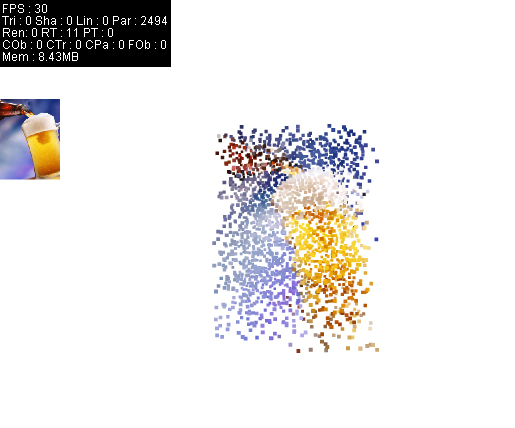
See it in action: http://ansuz.nl/toys/particles_from_image/pv3d/main.swf
To my surprise this is still running at 30 fps with almost 2500 particles in the view, I guess I need to do some more testing to see how many particles we can really push in there.
A next step is going to try this with Flint (particles), because that can easily handle 10-15K particles!
Flash live debugging
Just a quick note to remember.
Xray seems to be quite interesting to start using, you can use an external swf to debug your applications.
Links:
– OS Flas logging and debugging tools
– Xray project page
– Xray video tutorials
Deserializing data
When deserializing data, do it at the very first time you can and continue to use the deserialized data throughout your application. This will save you a lot of aggravation later on.
Take deserializing XML into (Value)Object(s), when you want to change the objects later on, say add, remove, alter properties you can easily do so, it’s quite a bit harder to insert a node or attribute into the (serialized) XML.
Links:
– (De)Serialization
Tortoise SVN – change repository credentials
When you save your credentials (aka username and password) when first connecting to a repository and try to access it but want to use different credentials it is a bit hard to find where to change this. In fact, you can’t change it, you can only clear the saved data so you’ll be prompted for credentials again.
Take the following steps to clear the stored credentials:
- Right-click on the root folder
- Select TortoiseSVN
- Select Settings
- Navigated to Saved Data
- Clear the stored Authentication Data
Source: http://johnnycoder.com/blog/2008/07/31/tortoisesvn-change-user-after-save-authentication/