The cone of uncertainty
The mythical man month
TBC…

The cone of uncertainty
The mythical man month
TBC…
I had the immense pleasure *ahem* of making a skin for the FLVPlayback component this week. I learned two valuable lessons from this:
I spent quite a lot of time figuring out why things didn’t work as expected, mostly due to the 2 points mentioned above.
TBC…
This all started out by a back-end colleague mentioning he wanted to try something like this and I was thinking to myself that it shouldn’t be too hard to achieve.
I’m reading out colour values per pixel of an image that I’m externally loading. Based on that info I create a shitload of particles in papervision, the effect is quite cool, but needs to be taken much further from here. Imaging what fun stuff you can do with this!
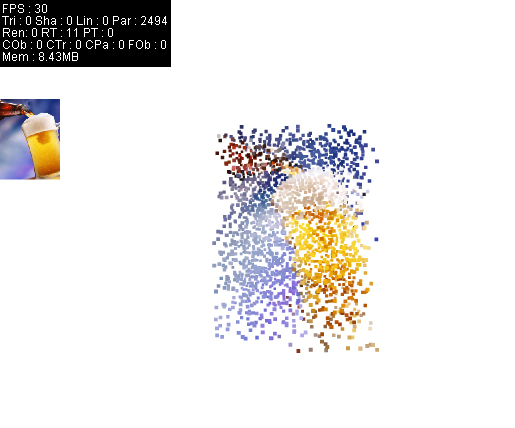
See it in action: http://ansuz.nl/toys/particles_from_image/pv3d/main.swf
To my surprise this is still running at 30 fps with almost 2500 particles in the view, I guess I need to do some more testing to see how many particles we can really push in there.
A next step is going to try this with Flint (particles), because that can easily handle 10-15K particles!
Just a quick note to remember.
Xray seems to be quite interesting to start using, you can use an external swf to debug your applications.
Links:
– OS Flas logging and debugging tools
– Xray project page
– Xray video tutorials
When deserializing data, do it at the very first time you can and continue to use the deserialized data throughout your application. This will save you a lot of aggravation later on.
Take deserializing XML into (Value)Object(s), when you want to change the objects later on, say add, remove, alter properties you can easily do so, it’s quite a bit harder to insert a node or attribute into the (serialized) XML.
Links:
– (De)Serialization
When you save your credentials (aka username and password) when first connecting to a repository and try to access it but want to use different credentials it is a bit hard to find where to change this. In fact, you can’t change it, you can only clear the saved data so you’ll be prompted for credentials again.
Take the following steps to clear the stored credentials:
Source: http://johnnycoder.com/blog/2008/07/31/tortoisesvn-change-user-after-save-authentication/
While working on a project of mine this weekend I discovered that there is another difference between pitch, roll, yaw and rotationX, Y, Z in Papervision. Pitch, roll and yaw both ‘rotate’ using the localRotationX, Y, Z, I knew that. What I didn’t know was the following:
When using yaw you are changing the rotationY property between -90 and 90. So when you use yaw and then read out the rotationY values for further calculations, you might be in for a nasty surprise. A way around this is just using rotationY.
09.00-10.00 Aral Balkan
Grab the Low-Hanging Fruit (or 5 Rules for Hedonistic Creatives)
I was too early to remember what his rules were. I did, however, take some notes of what striked me as interesting and worth knowing more about. I think the general idea of his talk was that we should not constrain our self to AS only, but also look at what else is out there. In other words: Think (and work) outside the box!
Have a look at Scratch for instance, a simple tool created by MIT to program. This might be really nice to do quick prototyping.
Another thing I want to have a look at is the Python programming language and / or Ruby on Rails.
Site: http://aralbalkan.com/
References:
http://scratch.mit.edu/ (Scratch)
http://ipython.scipy.org/moin/ (access to all python methods and docs through a command line iirc)
10.15 – 11.15 Niqui Merret
Accessibility – beyond the basics
A great talk about how to make Flash sites more accessible. Interesting to know is that Flex has accessibility turned off by default.
Use the AccessibilityProperties class to control the presentation of Flash objects to accessibility aids, such as screen readers. After setting all the properties don’t forget to call the Accessibility.updateProperties() method. Then check to see if MSAA is active, if it’s not queue the accessibility updates, set a delay for about 2 seconds and try again.
For pv3d it is advised to use the layers that are available in pv3d, though I think you could apply accessibility properties to any do3d.
Site: http://niquimerret.com/
References:
http://code.google.com/p/accessible/ (by Charles Brandt)
http://jadehopper.com/
11.30 – 12.30 Joa Ebert
Audiotool’s Private Parts
Joa is just brilliant. His talk was about how they optimized a lot of the Hobnox Audiotool. It was for the utmost importance that performance would be as good as possible, cause any delay would cause a hick up in the audio.
The first step was to improve how the cables between audio components were calculated. How you usually do that is in 3 steps.
To optimize this they made use of the Quadtree method. An added benefit of this was that they could reuse it to see if there was already a component in a spot when the user drags a new component on the screen.
The second optimization came from having a good look at garbage collection again. As you don’t control when this is going to happen it can cause unwanted delays. Their solution was tricking the garbage collector by using object pools. This way there is no object creation and no object destruction at runtime.
You have a list op pools with objects, kinda like this:
O –> O –> O –> O.
You take one out,
use it,
and put it back at the end when you’re done with it.
The third optimization came from creating their own event system. It turned out that Flash’s proprietary event system caused a lot of garbage collection to occur. By writing their own system they could stack events in the object pool, so no garbage collection would occur on events. Another benefit of writing their own event system was being able to implement it in their own way, a feature they added were winapi-like hooks.
A final tip was to have a console for each project, it is so easy to have one for debugging.
Site: http://www.joa-ebert.com/
References:
http://www.hobnox.com/audiotool.1046.html (Hobnox Audiotool)
http://en.wikipedia.org/wiki/Quadtree (Quadtree)
http://en.wikipedia.org/wiki/Object_pool (Object pools)
09.00-10.00 Richard Galvan
Flash now and in the future – keynote
10.15 – 11.15 Carlos Ulloa
The best way to predict the future is to invent it
Carlos spoke about pv3d and work planning. He talked about how they are working on a race game in pv3d and what they have done to come to the ‘final’ result. I put final in quotes, because they are not done yet and what he was showing was a beta, impressive none the less.
He referred to a couple of techniques they used to create the race track and AI, which reminded me a lot of the time when I had my internship at VESC / BumbleBeast (a sim / game developer in the Netherlands) about 4 years ago now. He was talking about using splines (lines in a 3d world) to lay out the track and using them for the AI and positioning (replay) cameras.
The most important thing to remember from his talk is to have a look at game developer forums and blogs if you want to do gaming in flash. There is a lot of information on gaming out there. You won’t find complete code for you, but you can probably use the idea or port some C# to AS.
Site: carlosulloa.com
11.30 – 12.30 Dr. Woohoo
Transforming ideas to pixels to atoms
He’s done some cool stuff and likes hooking up tools with each other. He especially like hooking the whole Adobe CS Suite together, Flash with InDesign with PhotoShop, etc… He does this by making use of the ExtendScript ToolKit (ESTK) and the cs3.swc. ESTK features a Scriptlistener that should help you get on your way to get to learn the CS3 API by seeing what functions are being used to perform certain actions, i.e. duplicate a layer in PhotoShop.
He created an interesting tool (Patch panel) to get him colour palettes for Illustrator from images loaded in a swf.
Site: http://blog.drwoohoo.com/
References:
http://www.blurb.com/ (Publish your own books)
http://inthemod.com/inthemod.html (In The Mod is dedicated to understanding the color palettes and hidden relationships of (in)famous paintings)
13.30 – 14.30 Mark Anders
A Preview of Flex 4 and “Thermo”
We all know by now how thermo is going to make developer and designer’s lives better by making layout easily interchangeable. Not majorly interesting, but learned a couple of things.
The most important one FXG is cool! This is a layout (and layout only) description language for Flex 4 (codename Gumbo).
Site: http://www.andersblog.com/
References:
http://opensource.adobe.com/wiki/display/flexsdk/FXG+1.0+Specification (FXG Standard)
14.45 – 15.45 Richard Lord
Creating particle effects with Flint
Particles ROCK!!! That’s basically all I have to say about it. I just want to go and play with this.
Some features:
-Â Â Â 2D and 3D particles
-Â Â Â Can easily handle 10-15K particles at one time
-Â Â Â PV3D and Away3D integration
Site: http://www.bigroom.co.uk/
References:
http://flintparticles.org/ (Flint)
16.00 – 17.00 Erik Natzke
Beyond the Knowledge: The Art of Play
Cool stuff by Erik Natzke! He’s taken about 2 years to develop a tool for him to paint using Flash. It is really amazing, you have to see it to believe it! Basically what he created is a 2D IK (Inver Kinematics) system to paint with.
So check some of his work:
-Â Â Â http://uk.youtube.com/user/eriknatzke
-Â Â Â http://www.flickr.com/photos/natzke/
Today in the office the weirdest request was made to me. The question was to disable a certain part of a website based on the user’s selected country and language. That doesn’t seem too strange when it’s a product that’s not available in certain regions. In this case, however, it was about disabling the option to share the website with others. This basically allows you to bookmark the page on Facebook, Reddit, etc.
This was a client request and based on the fact that countries like China don’t allow their people to surf to certain blogs and community sites.
So there you have it: I support censorship! :S